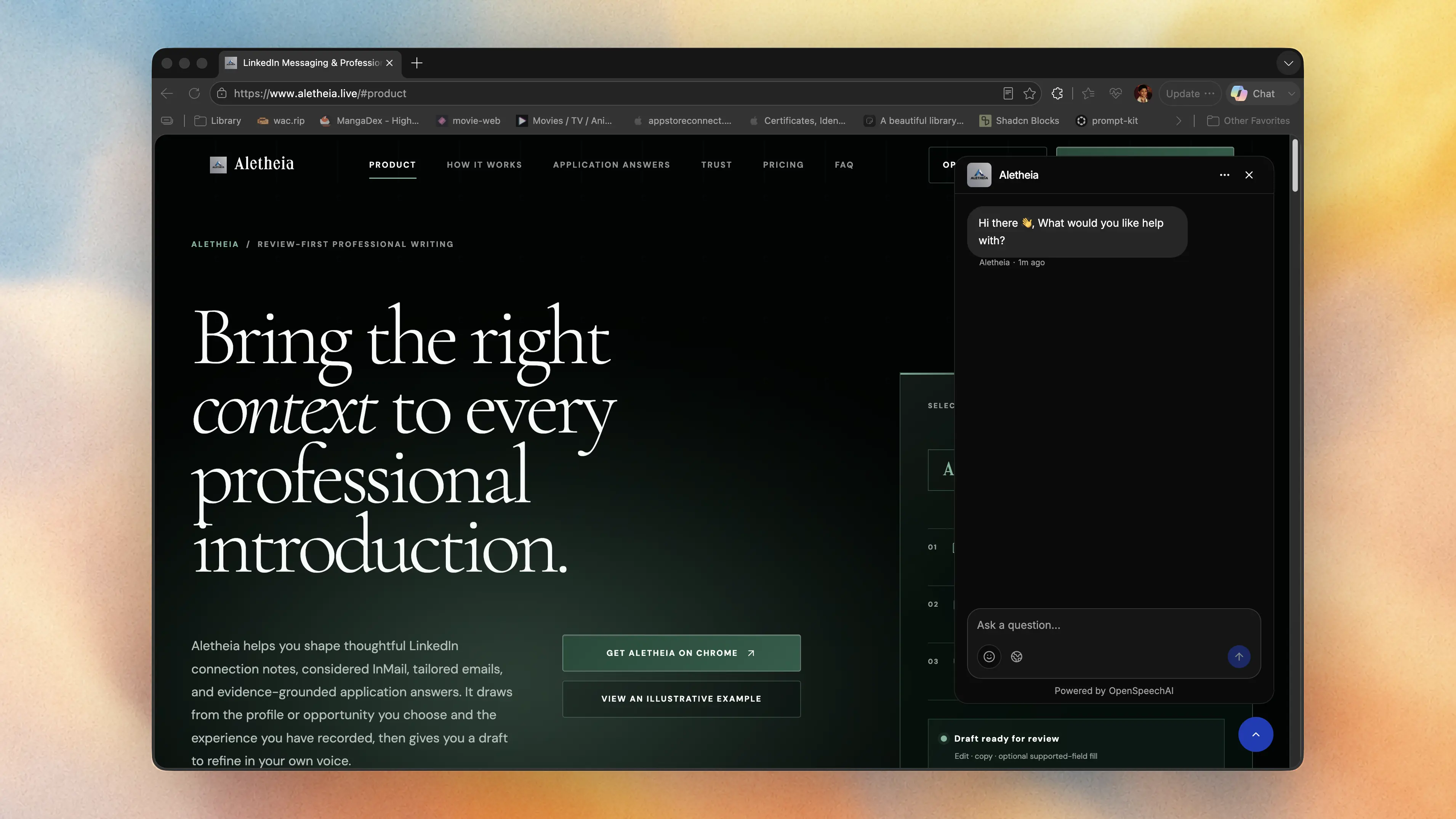
For an early-stage software business, answering visitors' questions is part of introducing the product. What does it do? How does it work? What information does it access? What happens after someone signs up?
Nagarjun Mallesh, Founder of Aletheia, encountered these questions while developing a tool that helps professionals prepare personalized outreach. By adding OpenSpeechAI to the website, Nagarjun gave visitors a conversational way to explore the product and share their contact details for follow-up.
This case study covers the initial rollout, which began around August 2026, and Nagarjun's reported experience. Quantitative results are still being assessed.
About Aletheia
Aletheia helps job seekers, professionals and founders prepare LinkedIn connection notes, InMail, networking emails, follow-ups, referral requests, role-fit responses and application answers.
Drafts use context selected by the user. Users review and edit them before sending; Aletheia does not automatically send messages on their behalf.
That distinction is central to the product, but visitors also need answers about personalization, privacy, credits and installing the Chrome extension.
The challenge: answering recurring questions while building the product
Before installing OpenSpeechAI, the founder relied on product pages, FAQs and installation instructions to explain Aletheia. When visitors contacted the founder directly, questions were answered personally.
The information existed, but visitors sometimes needed to search several pages to find it. Meanwhile, recurring questions about functionality, privacy, installation and pricing interrupted development and launch work.
The founder had not measured support hours or lost leads. The practical concern was simpler: visitors who could not quickly understand the product might leave before signing up or asking for help.
Aletheia needed a way to make its existing information easier to access without building a separate support system.
Turning existing content into a website assistant
The founder chose OpenSpeechAI to create a branded assistant using Aletheia's existing product information. OpenSpeechAI's knowledge-base guide explains how website pages, files and other approved sources become material the agent can use.
The agent's knowledge base included:
- Public product pages and FAQs.
- Installation instructions.
- Pricing and credit information.
- Privacy explanations and terms.
- Descriptions of the workflow in which users review drafts before sending.
The founder reported that no private customer information or confidential product data was intentionally included.
Setup involved creating the knowledge base, configuring the agent, customizing the widget and adding the supplied script to the website. The founder described the process as straightforward, although the exact setup time was not recorded.
The highest priority was accurate answers grounded in approved Aletheia content. Lead capture, conversation history and visual customization also mattered.
Helping visitors understand how Aletheia works
During the initial rollout, visitors could ask questions directly instead of piecing together answers from multiple pages.
According to the founder, OpenSpeechAI answered common questions about features, installation, privacy, credits and how users retain control over their drafts.
One reported interaction illustrates the value. A visitor asked what Aletheia does, how it uses selected context and whether it sends LinkedIn messages automatically. The assistant explained that Aletheia prepares drafts while leaving review, editing and sending under the user's control.
The founder reported that the visitor then provided contact information, creating an opportunity for a personal follow-up.
This is a summary of the founder's account, not a verbatim conversation.
Early results: clearer explanations and contacts for follow-up
The founder reported three useful changes during the initial rollout.
Visitors had a more direct way to understand the product. The assistant brought explanations of Aletheia's purpose, capabilities and workflow into one conversational interface.
Interested visitors could leave their contact details. The founder reported capturing details from multiple visitors and using them to follow up personally, understand their needs and begin building professional relationships. OpenSpeechAI keeps captured details in its contacts and form-submissions workflow.
Conversations revealed gaps in product messaging. Questions about personalization, privacy, automatic sending, installation and pricing highlighted areas where Aletheia's FAQs, documentation and onboarding could be clearer.
The founder also reported fewer repeated introductory explanations and a more manageable support process. These are qualitative observations: no verified support-deflection percentage, time-saving figure or purchase-conversion uplift is available yet.
"OpenSpeechAI made Aletheia easier for new visitors to understand and gave me a more structured way to answer questions and capture interested leads."
Nagarjun Mallesh, Founder of Aletheia
What the initial rollout has established
Aletheia is still establishing a representative traffic baseline. The founder has not yet verified exact conversation volume, automated-resolution rates, hours saved or purchases attributable to the widget.
A separate Supabase availability issue affecting Aletheia's application also limited continued testing. The founder did not identify it as a confirmed OpenSpeechAI issue.
The evaluation produced useful product feedback, including requests for clearer escalation controls, source or confidence indicators, more detailed lead attribution and clearer documentation about data handling.
These observations will help inform future evaluation as Aletheia gathers more usage data.
A practical starting point for a founder-led SaaS business
Aletheia's experience shows how a website assistant can make existing product information easier to explore and create opportunities for personal follow-up.
For its founder, the early value was having a consistent way to explain the product, answer recurring questions and learn what visitors wanted to understand.
As usage grows, the next step is to measure those observations against conversation records, lead outcomes and support effort.
Want to give visitors a conversational way to explore your product? View OpenSpeechAI pricing or read the setup guide.